How to make reading meaningful and engaging

In many classrooms, reading lessons are viewed as one of the least engaging parts of language learning. Even when teachers try to make them more dynamic with games or interactive activities, these efforts often fall short because the core of the lesson still revolves around answering comprehension questions.
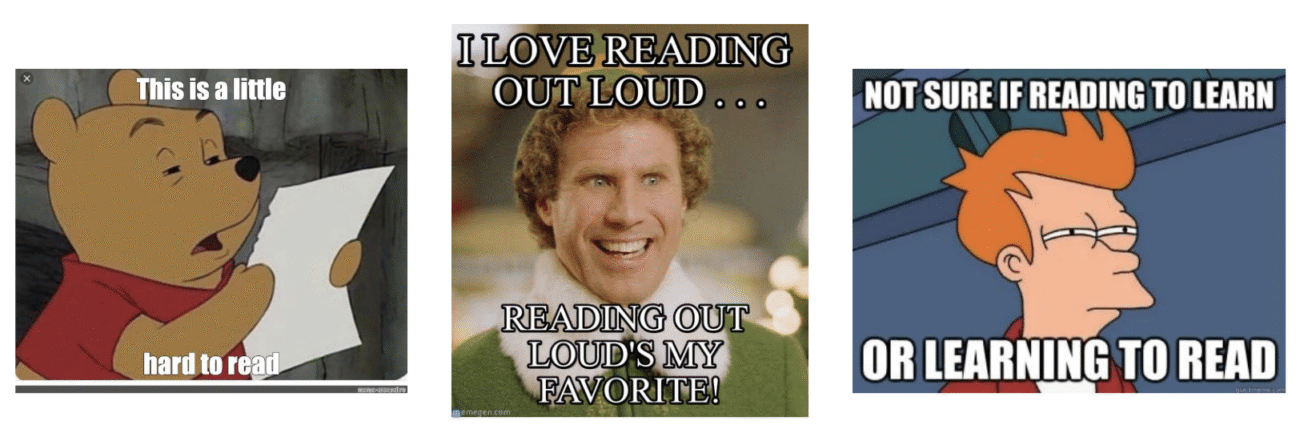
Why is it usually problematic?
According to Nuttall (1996), an overemphasis on completing comprehension tasks can encourage what she describes as mechanical “answer-hunting.” In this situation, learners focus mainly on locating specific pieces of information needed to answer questions rather than engaging with the overall meaning of the text. Therefore, lessons designed primarily to satisfy classroom requirements, rather than for meaningful purposes, often leave learners unmotivated and bored.
Nuttall suggests that a more effective approach is to design tasks that encourage learners to reflect on meaning and the text itself, justify their answers, and connect the text to their own experiences. Such activities can support deeper comprehension and foster greater interest in reading.
Similarly, Meddings and Thornbury (2009) note, “texts, when used, should have relevance for the learner, in both their learning and using contexts.”
In practice, however, teachers often have to work with coursebooks, which means using predetermined texts and exercises that may not connect to students’ interests or experiences. This raises the question of how teachers can use what coursebooks offer to make reading lessons more meaningful, interactive, and supportive.
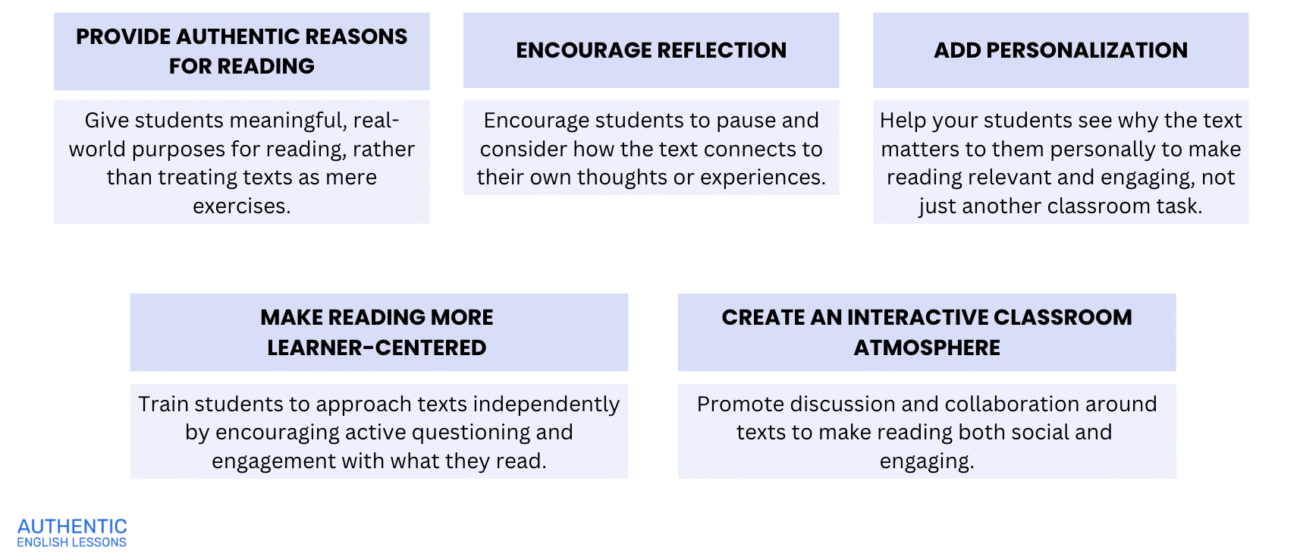
There are several strategies that can help make reading more meaningful, interactive, and motivating for learners.
Reading Activities
- Authentic Reasons for Reading
Arouse their curiosity
– Give Ss a provocative statement related to the topic. Ask them to agree or disagree, and then have them read to see how the text approaches it.
– Show a surprising fact or sentence from the text. Ask why Ss think it happens, and then have them read to find the explanation.
Create a knowledge gap with personal relevance
– Ask Ss about how they would handle a similar situation in real life. They can then read to discover how the text explains or approaches it.
– Ask Ss to recall a moment when they faced something related to this topic. They can then read to compare their experience with what the text describes. - Learner-Centered Reading
Encourage students to annotate the text by providing a series of symbols that learners could use to express their reactions to the text, e.g.
✓ I agree with this.
✗ I disagree with this.
? I don’t get it.
! I’m surpsired / shocked.
… I need more explanation.
lol This is funny.
After each section, ask them to write a short summary. This forces them to identify the core meaning independently. - Reflection
Apart from comprehension questions, ask Ss some of the following:
– Would you like to continue reading this text if it were longer? Why or why not?
– Who would you recommend this text to? Why?
– How would you rate the difficulty of this text on a scale from 1 to 10?
– How relevant is this text to your studies, work, or personal interests on a scale from 1 to 10?
– Which paragraph or sentence did you like the most, and why?
– What would you do if you were in the same situation as someone in the text? - Creative Personalization
Apart from comprehension questions, ask Ss to do some of the following:
– Create an alternative ending to the story or change the plot based on your own interpretation.
– Write a short blog post, social media post, or personal comment inspired by the text.
– Identify the main ideas of the text and suggest new perspectives that reflect your own experiences.
– Transform the text into a personal story or real-life example connected to your life.
– Compare the ideas in the text with your own experiences or cultural background. - Interactive Classroom Atmosphere
To promote collaboration and communication, try some of the following:
– Jigsaw reading: Each group / student reads a different section and teaches it to others.
– Text‑based debates: Ss prepare arguments supported by evidence from the text or their own lives.
– Ranking: Ss rank ideas, arguments from the text (most → least important / interesting), and defend their ranking.
– Perspective swap: Ss read the same text from different points of view and then discuss how their perspective influences/changes their understanding.
Sample perspectives:
– Critic / Expert – evaluates or questions the ideas
– The “opposite” viewpoint – someone who disagrees with the author’s opinion
– Friend or family member of a character/author – personal connection
Nuttall, C. (1996). Teaching reading skills in a foreign language (New ed.). Macmillan Heinemann.
Meddings, L., & Thornbury, S. (2009). Teaching unplugged: Dogme in English language teaching. Delta Publishing